
Awareness of Supply Chain Management
What is Supply Chain Management?
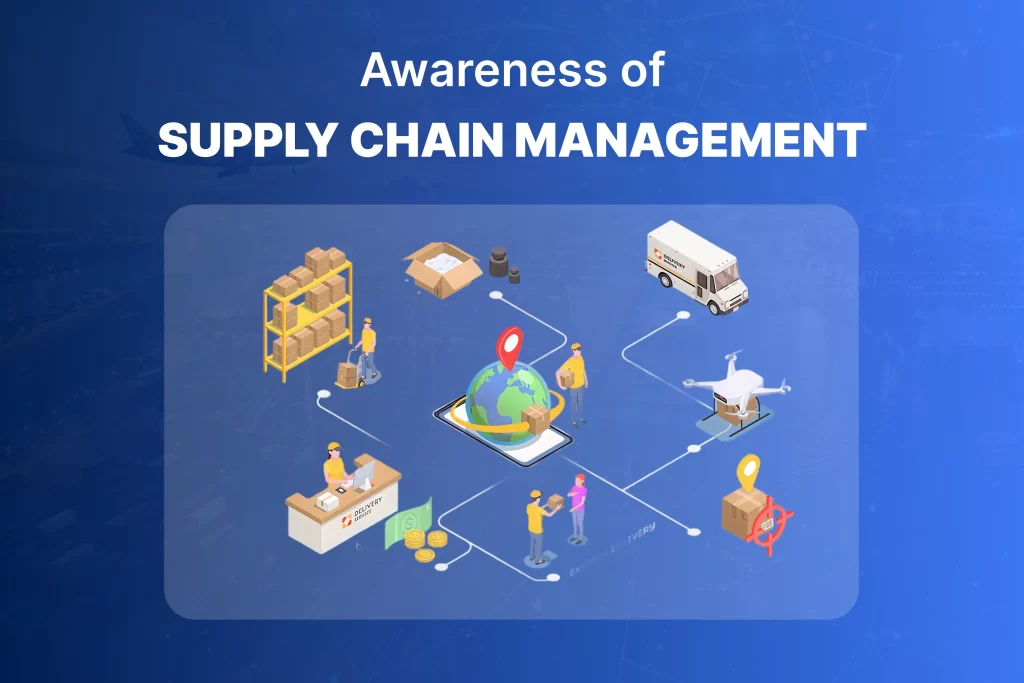
Supply chain management (SCM) aims to control the movement of information, products, and services. It travels to the customer from the source. It includes acquiring raw materials, manufacturing, distribution, transportation, and inventory management, among other operations.
The primary objective of SCM is to deliver goods to customers. This must be completed promptly, successfully, and economically, and quality standards must be maintained.
In today’s connected world, good supply chain management is key for businesses. It helps them stay competitive, meet market demands, and build lasting customer satisfaction.
Scope of Supply Chain Management
The coordination and management of all the processes required to manufacture and deliver goods is known as supply chain management or SCM. The raw materials are the first step in this procedure, and the final customer is the last. As technology advances and global marketplaces become more complex, the scope of SCM keeps growing.
Purpose of Supply Chain Management
Supply Chain Management (SCM) is crucial for the smooth operation of any business, including small startups and large multinational companies. The purpose of SCM is to manage how goods, services, and information move.
This happens through a network of suppliers, manufacturers, warehouses, and distribution centres. The goal is to deliver products to the final customer efficiently. SCM seeks to balance supply and demand. It aims to lower costs and improve operations. This helps boost customer satisfaction and business growth.
Supply Chain Management Process
SCM is about coordinating and managing a network of connected businesses. These businesses produce, handle, and distribute products or services. The process has several stages. Each stage helps move goods from raw materials to the final product delivery.
Below are the key stages of the supply chain management process:
Planning
The SCM process starts with planning. To satisfy demand and effectively manage resources, clear objectives, plans, and processes must be defined.
To meet the demands of consumers, businesses now need to evaluate their resources, initiate demand forecasting, and organise their supply chain. Planning must be done correctly to ensure that the other procedures run smoothly.
Sourcing
Sourcing means finding and choosing suppliers. These suppliers provide the raw materials, parts, or services needed to make the final product. The goal is to build strong relationships with dependable suppliers. They should deliver materials on time.
Manufacturing
The stage of manufacturing occurs when components and raw materials are transformed into final goods. The goals of this phase are to ensure the timely production of goods, meet quality requirements, and produce goods efficiently. To maintain efficient operations, manufacturers must also remember to schedule their workers and inventories.
Logistics
Delivery or logistics involves shipping and movement of commodities from manufacturing plants to warehouses, retailers, or final consumers. Effective logistic optimization provides prompt delivery of products, their quality and effectiveness.
Return
The return process is about how we handle products that customers send back.
This may occur due to flaws, end-of-life dissatisfaction, or recycling. Return management must be effectively implemented to avoid losses and ensure customer satisfaction.
It is also important from a sustainability perspective as it assists in managing waste and recycling.
Supply Chain Management Modules
SCM includes several connected parts. These parts help businesses manage and improve activities in the supply chain. These modules work together to make sure products are sourced, made and delivered efficiently and affordably. They also keep quality and customer satisfaction high.
Procurement and Sourcing Module
The procurement and sourcing module takes charge of procuring raw materials, components, and services that are required for production.
The module helps businesses procure reliable vendors, bargain for purchases, and oversee suppliers’ performances.
This module shields businesses from the loss of capability to purchase material at the highest price and quality, and the optimal vendor relations.
Inventory Management Module
The inventory management module helps businesses keep track of their inventory. It includes raw materials, work-in-progress, and finished goods. It keeps the ideal level of inventory to meet the demand of the customers without overstocking or understocking, thereby keeping holding costs minimal and stockouts at bay.
Production Module
This module is all about the manufacturing process. It deals with the management of production work orders and schedules. It also transforms raw materials into finished products effectively. It assists businesses in planning and controlling production processes, ensuring quality, cost, and timeliness.
Distribution Module
The logistics and distribution module manages the movement of goods from warehouses or factories to customers. It ensures delivery is timely and accurate. It optimizes transportation routes, manages shipping and delivery schedules, and handles third-party logistics (3PL) partners.
Sales and Order Management Module
This module manages the entire order fulfilment process, from receiving customer orders to delivering the product. It makes sure that orders are processed correctly. It updates inventory in real-time. Customers are kept informed about their order status.
Forecasting Module
The demand planning and forecasting module aids companies in forecasting future demand for products. It is dependent upon history, market trends, etc. It aids companies in preparing for changing demands, optimizing the inventory, and planning production accordingly.
Analytics Module
The module gives up-to-the-minute information and data to monitor the performance of the entire supply chain. It enables organizations to monitor such critical indicators as order status, inventory position, lead time, and shipping performance.
It even allows organizations to make fact-based decisions, streamline operations, and pinpoint areas for improvement.
Vendor Management Module
The vendor and supplier management module is employed to develop and sustain healthy business relations with the suppliers. It also ensures their performance at the business level.
It includes monitoring the performance of suppliers, contract management, and timely delivery of quality material.
Returns Management Module
It addresses customers’ reverse flow of goods, i.e., returns, repairs, exchange, and recycling. Reverse logistics is significant when it comes to customer satisfaction as well as sustainability. Reverse logistics helps address products in a life cycle finishing stage.
Supply Chain Risk Management Module
The module for managing risks assists companies in recognizing, analyzing, and managing risks capable of interrupting the supply chain. This involves scanning for possible interferences like natural disasters, economic conditions, geopolitics, or supply shortages.
Proactiveness in risk management positions the business to be able to adapt and conduct business uninterrupted.
Hence, by combining these modules, companies can streamline their processes, save costs, and enhance customer satisfaction. With advancing technology, SCM modules are becoming smarter. This enables companies to react instantly to changes in the market and expand.
Supply Chain vs Operations Management
Supply Chain Management (SCM) and Operations Management (OM) both work towards improving efficiency and cutting costs within a business. They do so in different capacities, however.
SCM deals with coordinating and transporting goods, information, and services. It starts with raw material suppliers and ends with the customer. It involves managing supplier relationships, logistics, procurement, inventory, and distribution channels. SCM is concerned about ensuring that products arrive at the destination in time, at the right cost, and in the right condition.
On the other hand, Operations Management is concerned with the internal operations that produce goods or services. It is interested in managing production, quality control, labour management, and operational efficiency within the company.
SCM looks at the end-to-end supply chain network. OM focuses on optimizing day-to-day operations within the firm. SCM focuses on relationships with suppliers, partners, and customers outside.
Meanwhile, OM looks into the operations and manufacturing of a company. They are both determinants of company success. SCM coordinates the materials and information flow smoothly using a network. OM optimizes the internal operations for delivering product and service quality while efficiently working.
Types of Costs in Supply Chain Management
There are many expenses at every step in SCM. The steps involve procurement and distribution. These costs have to be understood and managed to ensure profitability and operational effectiveness.
Procurement Costs
Procurement costs refer to the expenses associated with acquiring raw materials, components, or services from suppliers. These costs include everything from identifying suppliers to negotiating prices and purchasing goods.
Transportation Costs
Transportation costs are the expenses of moving goods from one place to another. This includes moving items from suppliers to factories or from warehouses to customers. These costs can vary depending on the transportation mode (truck, air, rail, sea), distance, and shipping volume.
Production Costs
Production costs are the expenses associated with turning raw materials into finished products. This category includes direct costs like labour, machinery, and materials. It also includes overhead costs for running the production facility.
Warehousing Costs
Warehousing costs are the costs associated with storing, handling, and managing products in a warehouse. This includes costs for space, equipment, labour, and technology to ensure smooth operations.
Packaging Costs
Packaging costs are incurred when goods are packaged for shipping, protection, and presentation. This includes the materials used for packaging, as well as labour and machinery required for packaging.
Supply Chain Management Tools
Supply Chain Tools help companies improve their processes. They lower costs, boost efficiency, and ensure goods, services, and information move smoothly.
Enterprise Resource Planning (ERP) Systems
ERP Systems are comprehensive software solutions that integrate core business functions, including procurement, manufacturing, inventory management, sales, and finance, into one unified system.
These systems assist companies in streamlining operations, monitoring real-time information, and enhancing decision-making. With centralized data, ERPs guarantee that all departments see the same information, mitigating mistakes and inefficiencies.
Warehouse Management Systems (WMS)
Warehouse Management Systems (WMS) are designed to aid in a warehouse’s day-to-day operation. Business products allow a business to track inventory, optimize storage, and track products as they move around in a warehouse. WMS products improve picking, packing, and shipping operations, reduce mistakes and accelerate the delivery process.
Supply Chain Visibility Platforms
Supply Chain Visibility Platforms allow for real-time tracking and monitoring of goods as they transit through the supply chain. These platforms gather data from different sources. They build a complete picture of the supply chain.
This allows for tracing products from suppliers to consumers. These tools allow for minimizing risks, avoiding delays, and responding.
Conclusion
SCM in the interconnected world of today is not a sequence of procedures. It is the backbone of any successful business.
SCM is important in acquiring raw materials and delivering the finished product to the consumers. SCM guarantees efficiency, cost reduction, and customer satisfaction. Organizations are facing greater pressure for speed, customization, and sustainability. Because of this, the need for better supply chains is greater than ever.
Through the use of the right tools, embracing data analytics, and having good relationships with suppliers, businesses can build strong supply chains. These supply chains are resilient to disruptions and flourish in a volatile market. Effective SCM is necessary to gain a competitive edge in today’s age. It reduces costs, increases efficiency, and provides customer satisfaction.
People also ask about Supply Chain Management:
What is the use of SCM?
SCM is used to increase efficiency, logistics optimization and provide customer satisfaction.
What is the first step to be carried out in the SCM process?
The first step of SCM is Planning.
List some SCM tools.
The most famous SCM tools are Enterprise Resource Planning (ERP) and Warehouse Management Systems (WMS).
How does SCM affect the working of a business?
SCM affects the working of a business by increasing efficiency, reducing costs and improving decision-making.