What Is Delivery Management Software? Everything You Need to Know
Struggling to keep track of deliveries? How do businesses easily manage hundreds of orders every day? Delivery management software makes it possible. This blog will explain what delivery management software is, how it works, its key features, benefits, and provide tips on choosing the right solution. By the end of this blog, you will exactly understand how this software is the perfect solution to streamline your logistics needs.
Understanding Delivery Management Software
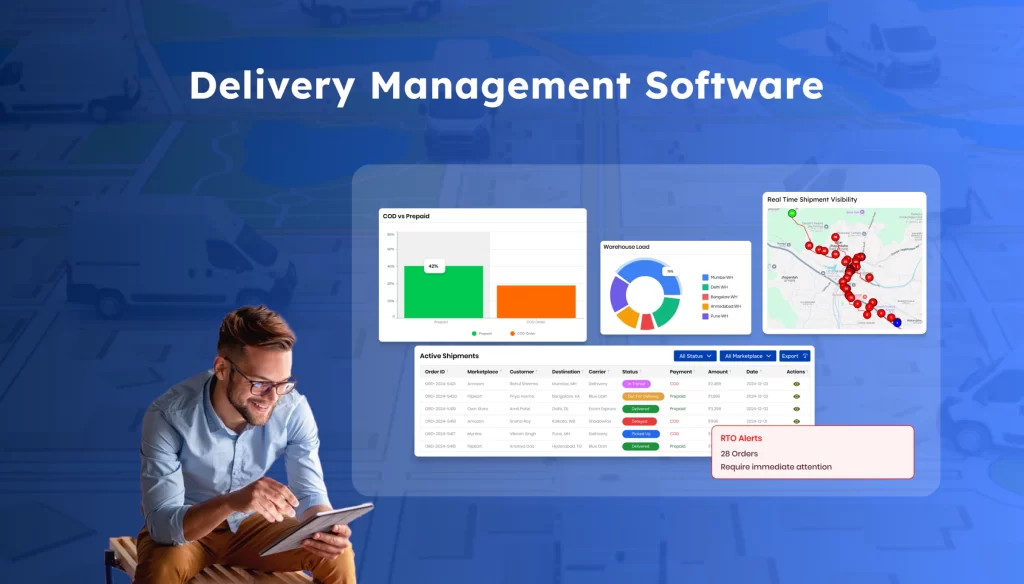
Delivery management software is a tool that helps to handle deliveries efficiently. It tracks orders, assigns tasks to drivers, plans optimal routes, and monitors progress in real time. The software makes sure that every order is delivered on time. It minimises delays, prevents errors, and cuts extra costs, allowing businesses to no longer rely on spreadsheets or phone calls.
It is used across industries, from e-commerce stores and food delivery services to logistics companies and pharmacies. Any business that delivers products or packages can benefit from this software. At its core, the process is simple. An order is received, assigned to a driver, routed efficiently, and tracked until delivery is complete. Customers can receive automatic updates through SMS or email, which keeps them informed.
Overall, the software saves time, reduces operational stress, and also helps in improving customer satisfaction. It gives businesses control over the process of delivery and helps them scale efficiently.
Step-by-Step: How Delivery Management Software Gets the Job Done
Delivery management software makes the entire process of delivery simple. It takes care of every step, from order placement to final delivery.
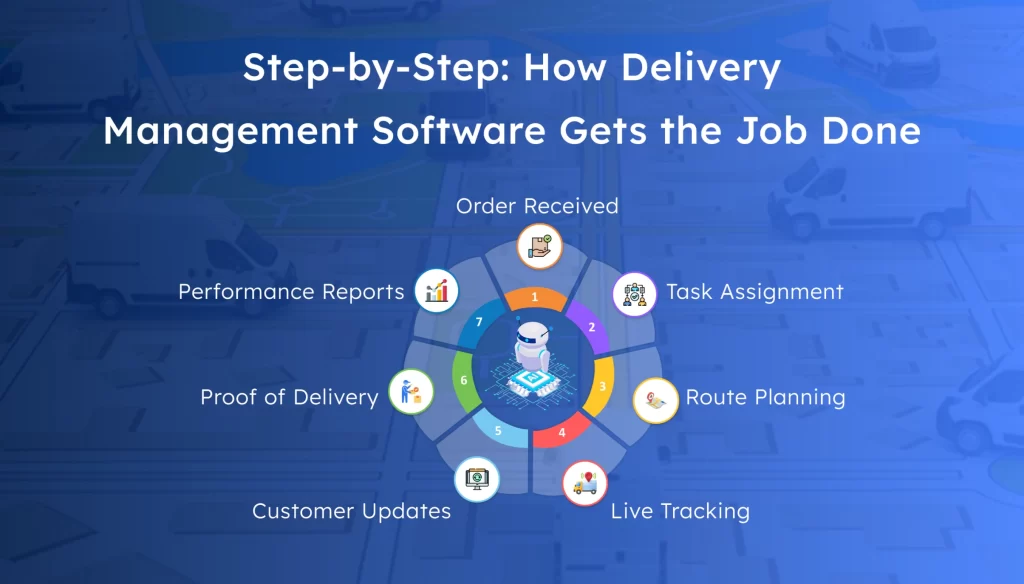
Here’s how the entire process works:
- Order Received: The system automatically collects new orders.
- Task Assignment: Orders once received are assigned to available drivers based on location and capacity.
- Route Planning: After the task assignment, the software automatically creates the fastest and most efficient routes, as the route optimization software works.
- Live Tracking: By using the software, businesses can easily track drivers in real-time and monitor progress.
- Customer Updates: The software automatically sends notifications to customers with ETAs and status updates.
- Proof of Delivery: Each delivery ends with proof: a signature, a photo, or an OTP entered by the driver. Features like contactless delivery can be made possible using the DMS.
- Performance Reports: Managers can easily review delivery times, delays, and driver performance.
This easy step-by-step process provided by the system helps in reducing errors and saves time. It also helps businesses in handling more deliveries with fewer resources. Customers stay informed, which in turn helps improve the overall experience.
Key Features of Delivery Management Software
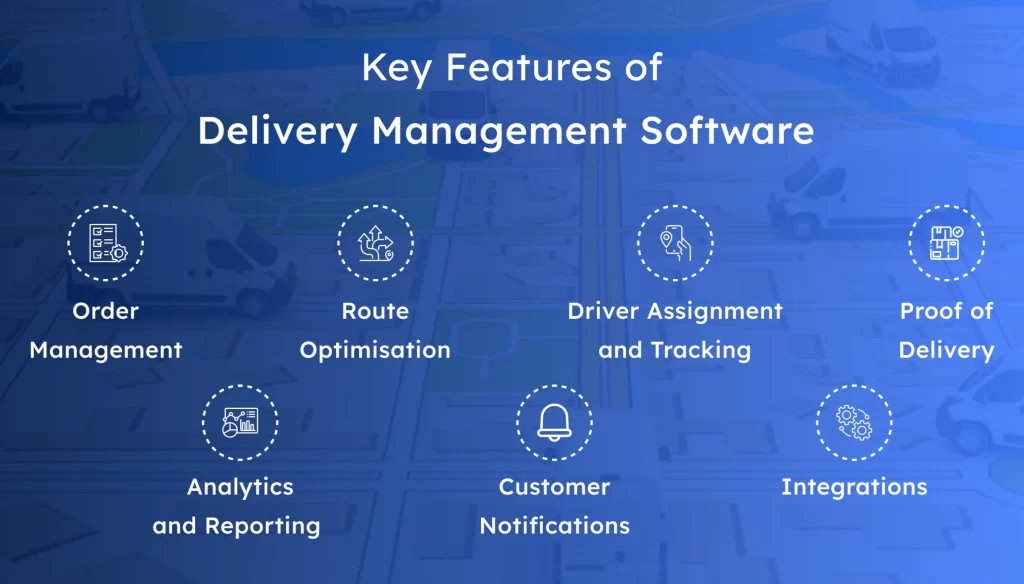
Delivery management software is not just a tracking tool. It is built to simplify every step of the delivery process, helps in improving the efficiency of the team, and also creates a better experience for the customers. Here are some of the key features that the delivery management software offers:
Order Management
Every order that is received is collected in one dashboard, whether it is received from an online store, app, or phone. Teams can easily edit the order details and update order status without the need to manage different spreadsheets or multiple tools. This helps in keeping everything organised and also reduces errors.
Route Optimisation
The software uses smart algorithms to create the most efficient routes. It considers distance, traffic, and driver availability before suggesting any route, which helps in reducing travel time and saving fuel. Similar to a multi-stop route planner, using DMS allows drivers to complete more deliveries in a day.
Driver Assignment and Tracking
The tasks are automatically assigned to the right driver based on their location, capacity, and schedule. Managers can easily track each driver’s position in real time, which makes it easy to respond quickly if an issue arises or reroute deliveries when needed.
Customer Notifications
Customers stay updated throughout the process. They receive constant alerts of when their order is out for delivery, updates about delays, and an ETA so they know when to expect it. These notifications can be sent through SMS or messaging apps, which helps in improving transparency and trust.
Proof of Delivery
The process of each delivery ends with a clear confirmation. Drivers can collect a digital signature, snap a photo, or enter an OTP to verify successful delivery. This helps in creating a record for the business and also helps in reducing disputes about missing packages.
Analytics and Reporting
The system automatically tracks the delivery times, delays, completion dates, and even the driver’s performance. These detailed reports help managers to identify trends, spot mistakes, and make better decisions to improve future deliveries.
Integrations
It connects with CRMs, ERPs, e-commerce platforms, and other supply chain management software. This helps to keep the data in sync, reduces manual entry, and also ensures a smooth flow from order placement to delivery.
Delivery Management Software v/s Transportation Management System.
Many people often tend to confuse a delivery management software (DMS) with a transportation management system (TMS). While both these software help to manage the movement of goods, they serve different purposes. Here is a clear comparison table showing the exact difference between the two.
| Aspect | Delivery Management System (DMS) | Transportation Management System (TMS) |
|---|---|---|
| Focus | Designed to manage last-mile deliveries like the last mile delivery software and real-time tracking for faster, accurate drop-offs. | End-to-end transportation across supply chains |
| Scope | Handles order assignment, route planning, live tracking, and proof of delivery | Plans, books, and optimizes freight shipments across multiple carriers |
| Users | Delivery teams, dispatch managers, operations staff | Logistics managers, supply chain planners, freight coordinators |
| Key Features | Route optimization, driver tracking, customer notifications, proof of delivery | Freight planning, carrier selection, shipment tracking, freight cost management |
| Goal | Faster, accurate, and efficient deliveries to customers | Reduce transportation costs and improve overall logistics efficiency |
| Industries | E-commerce, food delivery, courier services, pharmacies | Manufacturing, retail supply chains, import/export businesses |
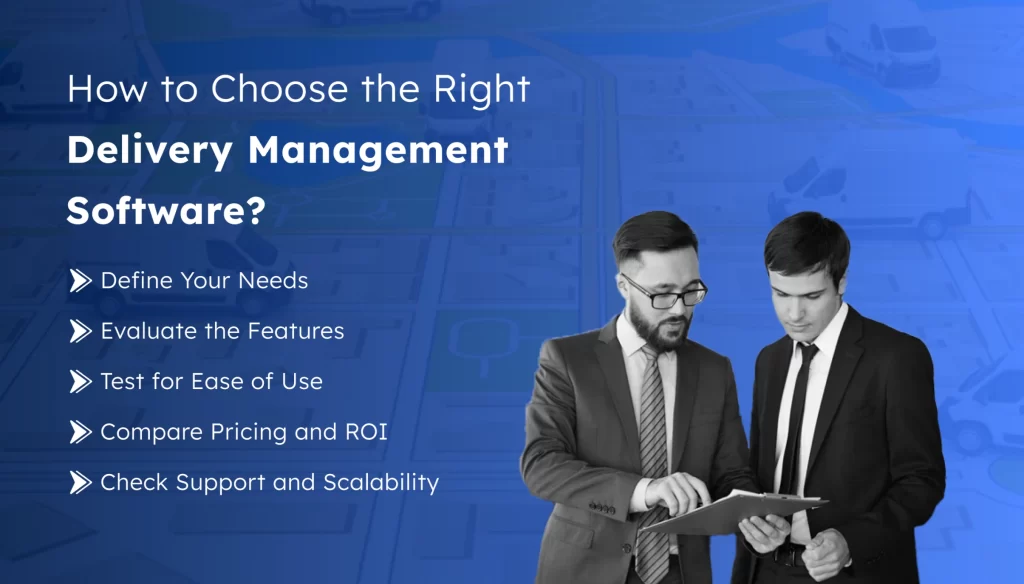
How to Choose the Right Delivery Management Software?
Not every delivery management software is the same. Picking the right software can help you save time, reduce costs, and keep customers happy. Here is a simple 5-step framework that helps you choose the right software:
Step 1: Define Your Needs
Start by listing what your business really needs. Think about the number of deliveries, drivers, and also the locations. Listing all of this makes it clear which features matter the most.
Step 2: Evaluate the Features
Look for features like route optimisation, live-tracking, proof of delivery, and customer notifications. The software you choose should have all these features and handle the entire delivery process end-to-end.
The delivery management software provided by FleetronX offers all of these core features from a single dashboard that helps you plan, track, and confirm deliveries without switching to different tools.
Step 3: Test for Ease of Use
A software that is good should be easy to learn. Start by using a free trial with your team and see how quickly they can adapt. To avoid any future problems, choose the delivery management software provided by FleetronX, which has a simple, intuitive interface that even first-time users can navigate with ease.
Step 4: Compare Pricing and ROI
Do not just choose the cheapest option. It is also important to look into how much time, effort, and fuel the software can help you save.
Step 5: Check Support and Scalability
Good customer support turns out to be very important. Make sure the software you choose grows with you as delivery volumes increase. Look for a software provider like FleetronX that provides continuous support, from training your team in the beginning to making sure that the software simplifies your process.
Real-Life Examples of Delivery Management Software in Action
It is easier to see the value of delivery management software when you look at the real examples. Here is how businesses solved their delivery challenges by choosing the right DMS.
Case Study 1: E-commerce Brand
Challenge
This growing e-commerce business was handling 300+ orders in a day, which often led to delays in deliveries and planning routes manually. Customers always complained about not knowing exactly when their package would arrive.
Solution
The business implemented a delivery management system that automated route planning and sent real-time SMS updates to customers, much like online shipment tracking software, so customers always knew where their package was. Drivers also received optimised routes on their phones, which reduced the delay rates and the confusion.
Results
Late deliveries dropped by 30% and support calls and messages regarding “where is my order” dropped by 40%. Customer satisfaction scores improved, and repeat purchases went up.
Case Study 2: Restaurant Chain
Challenge
A chain of restaurants that offered home delivery struggled to manage deliveries during peak dinner hours. Orders piled up, drivers took long routes, and food often arrived cold.
Solution
They adopted DMS with live driver tracking and automatic driver assignment. The system assigned deliveries to the nearest available driver and optimised routes to avoid traffic.
Results
Deliveries turned out to be 25% faster than before, the overall fuel cost reduced by 20%, and customer complaints about cold food almost disappeared. The business was now easily able to handle 15% more orders without even hiring extra drivers.
FleetronX: Your Partner For Smarter Deliveries
You have already seen how a delivery management system can transform businesses. If you are ready to get the same results, FleetronX is here to help you out.
With FleetronX, you can:
- Plan routes automatically in seconds.
- Track every order live and stay in control.
- Easily capture and store the proof of delivery.
- Notify customers instantly about the status of their orders.
- Scale easily as your business grows.
The delivery management software provided by FleetronX is designed to make deliveries faster, more accurate, and less stressful for managers, drivers, and even customers.
Ready to see all of this in action? Book a free demo today.
Take Your Deliveries to the Next Level
Fast, error-free deliveries are no longer a luxury; instead, they have turned out to be an expectation. A delivery management system helps businesses to plan better, track every order easily, and keep customers happy.
By understanding how DMS works, comparing it with TMS, and following a clear checklist to choose the right solution, you can easily take control of your daily operations.
When you are ready to get started, FleetronX is here to help you out and make every step easy, from route planning to proof of delivery.
Frequently Asked Questions(FAQs) About Delivery Management Software
What is Delivery Management Software (DMS)?
A Delivery Management System (DMS) is a software solution designed to streamline and optimize the entire delivery process. It encompasses various tools and features to manage and monitor deliveries from start to finish, ensuring that products are delivered to customers efficiently and on time.
How much does a Delivery Management System cost?
The cost depends on your business size, delivery volume, and features. Most providers offer custom pricing plans.
Is training required to use a DMS?
While many DMS platforms are designed to be user-friendly, training may be necessary to ensure all users can utilize the system effectively. Most providers offer onboarding sessions and support materials to assist with the transition.
What industries can benefit from a DMS?
DMS helps industries like e-commerce, food delivery, healthcare, and retail manage deliveries efficiently.
Can a DMS help in reducing delivery costs?
Yes, a DMS can optimize delivery routes, reduce fuel consumption, and improve driver productivity, all of which contribute to lowering overall delivery costs.
Can a DMS handle same-day or express deliveries?
Yes, many DMS platforms support same-day and express deliveries by optimizing routes and prioritizing urgent orders.
Does a DMS work for small businesses, too?
Absolutely. Even small businesses benefit from automated routing, real-time tracking, and proof of delivery to save time and improve customer satisfaction.
How quickly can a business implement a DMS?
Implementation usually takes a few days to a few weeks, depending on the size of the business and the complexity of operations.