
Contactless Delivery in 2025: Smarter, Safer, and Built for Every Industry
During the COVID-19 era, the way we shopped and received goods changed almost overnight. Phone notifications, doorstep drop-offs, and no-handshake exchanges replaced the very usual delivery practices that had face-to-face delivery handovers. What was initially a safety measure a few years back gradually turned out to be a convenience that people did not wish to give up.
Fast forward to 2025, contactless deliveries no longer remain a matter of hygiene; instead, they have turned out to be about speed, efficiency, and seamless customer experience. Today, businesses rely on advanced tools like Delivery Management Software to ensure seamless, safe, and efficient deliveries. Whether it is about a retail order, a contactless home delivery for groceries, or even contactless food delivery, customers have now started to expect a smooth and tech-powered experience every time.
In this blog, we will try to explore how contactless delivery technology works, the future trends, and how advanced software can be used to make the process of contactless delivery seamless. From including drones to AI-powered specialisations, contactless delivery is completely reshaping the way in which businesses handle last-mile delivery.
What Exactly is Contactless Delivery?
Contactless delivery is a method of getting goods to customers without having any direct physical contact between the courier and the recipient. This just began as a safety measure during the COVID-19 pandemic, but has, with time, evolved into a convenience and efficiency standard across multiple industries.
In the basic contactless delivery system, customers place an order online, pay for it digitally, and receive their package without the need for any in-person handover. Items are left at a designated spot, like a doorstep, parcel locker, or any desk, and the recipient is notified about the delivery either through SMS, email, or through an app alert and are tracked in real time through online shipment tracking software.
Future Trends of Contactless Delivery
Contactless Delivery has come a long way since its rapid rise in 2020. What began as a quick method to minimise human contact during COVID-19 transformed into a full-fledged delivery model that prioritises speed, efficiency, and convenience.
In earlier times, the model of contactless delivery was as simple as leaving a package at the doorstep and sending a text to inform the customer. By 2025, contactless delivery technology will have evolved into a sophisticated system that involves GPS-based tracking, automated system updates, digital proof-of-delivery, and integrations with business platforms.
Where Is The Technology of Contactless Delivery Heading Next
The future of contactless delivery promises even more innovation, from the inclusion of drones and autonomous vehicles for delivery to AI-powered scheduling, where the time for delivery can be easily scheduled according to the routine of the customer. Along with this, the use of electric vehicles, reusable packaging, and eco-friendly materials will also dominate the market.
These trends show that contactless delivery isn’t just here to stay; it’s becoming the backbone of modern logistics. For businesses, staying ahead means adopting flexible, future-ready contactless delivery solutions that can adapt as customer expectations and technology evolve.
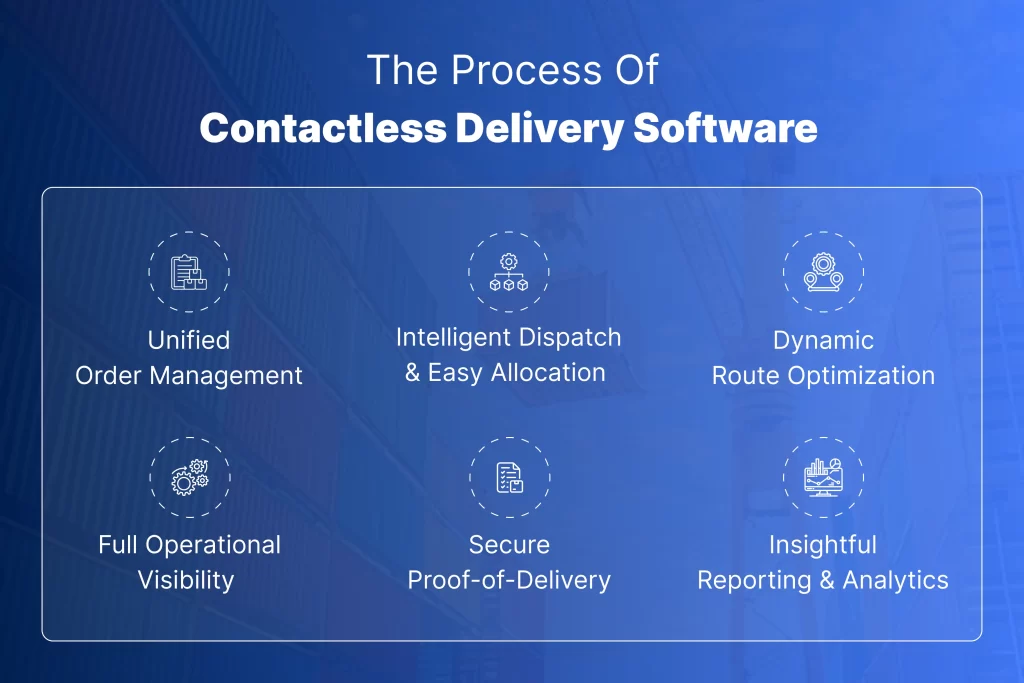
The Process Of Contactless Delivery Software
When we think of contactless delivery, we consider it as simple as a “drop at the door” service. But for businesses, it turns out to be important to understand the engine powering it, and this is why it is important to understand the backend process that keeps the process of delivery seamless, secure, and highly scalable.
Unified Order Management
The contactless delivery software integrates easily with e-commerce store systems, POS systems, or any other ordering app to bring all orders into a single dashboard in real time. Whether you’re a restaurant, retailer, or logistics provider, you’ll never lose track of an order again.
Intelligent Dispatch and Easy Allocation
The software, once installed, takes up all the hectic tasks of manual assignment. The system automatically assigns the right delivery to the right driver using the live data that includes location, traffic, which makes the process of delivery seamless without any micromanagement.
Dynamic Route Optimization
The AI engine of the route optimisation software combined with last-mile delivery tracking software, constantly updates delivery routes based on real-world conditions. If traffic, weather, or new orders pop up, it adapts instantly to save time and fuel.
Full Operational Visibility
The software enables managers to track every single delivery in real time, communicate easily with the drivers, and make adjustments on the fly using a single control panel, which helps ensure that the service stays smooth even on the busiest days.
Secure Proof-of-Delivery
Every completed delivery is recorded with GPS coordinates, a timestamp, a QR scan, or photo proof. This builds trust, eliminates disputes, and ensures compliance.
Insightful Reporting & Analytics
The software automatically compiles delivery performance data so you can identify bottlenecks, cut costs, and plan for growth with confidence.
With a process like this, contactless delivery becomes more than a customer convenience; it becomes a strategic business advantage.
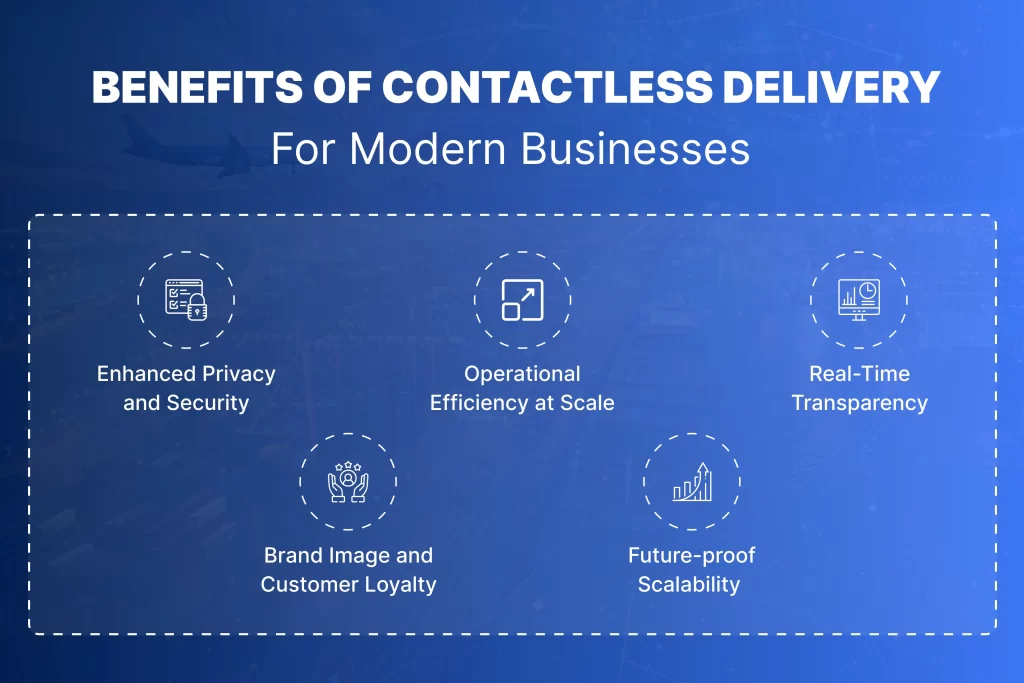
Benefits of Contactless Delivery For Modern Businesses
While contactless delivery started as a public health necessity, it has now become a business differentiator. With the right contactless delivery technology, companies can gain far more than safety; they can unlock efficiency, trust, and long-term growth.
Enhanced Privacy and Security
Customers expect their deliveries to be discreet and secure. Contactless systems record every step, from dispatch to final drop, using encrypted GPS tracking and proof-of-delivery methods. This protects both your customers’ privacy and your brand’s credibility.
Operational Efficiency at Scale
Manual order assignments, paper logs, and inefficient routes eat up time and money. Contactless delivery software automates these steps, allowing you to handle more orders with fewer resources, without compromising quality.
Real-Time Transparency
When customers and managers can both track deliveries in real time, trust skyrockets. Your team can respond to delays before they become complaints, and customers feel informed without the need for constant calls or follow-ups.
Brand Image and Customer Loyalty
Today’s customers value convenience, safety, and reliability. Offering fast, contactless delivery backed by professional software positions your brand as forward-thinking, encouraging repeat orders and word-of-mouth referrals.
Future-proof Scalability
As your business grows, so do your delivery demands. Contactless delivery technology is designed to scale seamlessly, supporting new locations, larger fleets, and higher order volumes without a drop in efficiency.
Why FleetronX is the Smart Choice for Contactless Delivery
When it comes to contactless delivery, the software you choose defines the quality of service you can provide. FleetronX isn’t just another delivery management tool; it’s an end-to-end solution designed for modern businesses that need speed, accuracy, and control.
One of FleetronX’s biggest advantages is how effortlessly it fits into your existing setup. It integrates smoothly with e-commerce platforms, POS systems, and ordering applications, meaning you can launch contactless home delivery, contactless food delivery, or any other delivery service without disruptive changes.
At its core, FleetronX relies on AI-driven dispatch and routing to match each order with the most appropriate driver and deliver it along the quickest possible route. Real-time updates keep deliveries running smoothly, even when traffic, weather, or unexpected events get in the way. Managers maintain full control of operations, monitoring every delivery in real-time, making immediate changes as necessary, and maintaining seamless service during even the most hectic times.
Security and accountability are embedded in each delivery. FleetronX logs GPS coordinates, timestamps, QR code scans, and photo evidence for each successful order, all safely stored for compliance and for resolving disputes. Such transparency not only safeguards your business but also earns the trust of your customers.
With FleetronX, you’re not simply keeping up with customer expectations; you’re setting a new standard for delivery excellence. In 2025 and beyond, smart, contactless delivery isn’t just an option. With FleetronX, it’s your competitive advantage.
Quick Tips For Contactless Delivery
Switching to contactless delivery isn’t just a technology decision; it’s a business strategy. The key is to start with the right software that integrates smoothly into your existing systems, scales as your business grows, and provides the visibility you need to run operations without interruptions.
From there, focus on smooth adoption. Train your team to use the platform’s features to their full potential, track performance from the start, and keep refining processes based on real-time insights. The more your software works in sync with your operations, the easier it becomes to deliver a seamless, safe, and reliable experience for every customer.
In 2025, contactless delivery is no longer an optional add-on, it’s an expectation. With FleetronX, you’re not just meeting that expectation; you’re setting the benchmark for efficiency, security, and customer satisfaction in the contactless era.
All You Need To Know About Contactless Delivery Technology
What is Contactless Delivery Software?
Contactless delivery software is a digital solution that enables businesses to manage and complete deliveries without direct physical contact between drivers and customers. It automates order dispatching, optimizes delivery routes, tracks deliveries in real time, and provides secure proof-of-delivery; all while keeping operations safe and efficient.
Can small businesses benefit from contactless delivery solutions?
Absolutely. FleetronX is designed to be scalable, meaning it works just as well for small local businesses as it does for large enterprises. You can start with a small delivery fleet and expand as demand grows, without having to change platforms.
Why should my business invest in contactless delivery now?
Customer expectations have shifted since COVID-19, and convenience, speed, and safety are now non-negotiable. Businesses that adopt contactless delivery software like FleetronX gain a competitive edge by meeting these demands while improving operational efficiency and reducing costs.
Can FleetronX support international deliveries?
Yes. FleetronX supports multi-location and cross-border delivery management, making it suitable for businesses expanding into new markets.
What happens if customers aren’t home during contactless delivery?
Protocols vary, but common practices include leaving the package in a designated spot (e.g., doorstep), attempting contactless notification, or letting customers reschedule via the app, then logging the action with photo or GPS proof.
What about age or identity verification with contactless delivery?
When delivering restricted items (e.g., alcohol or prescriptions), systems can require digital ID verification or OTP before drop-off, ensuring compliance despite no physical interaction.
Does contactless delivery increase operational costs?
Initially, there may be setup costs, like software subscription or mobile device deployment. But AI routing, fewer redeliveries, and paperless systems often lead to overall cost savings.